Care4Care · Applied Research on Work & Well-Being
Designing, operating and analysing a six-country study of working conditions and well-being
I worked across the operational and quantitative research lifecycle of Care4Care, a European project examining the working conditions and well-being of care workers. My role combined hands-on research delivery with quantitative analysis under the scientific supervision of senior researchers at the University of Seville.
Six-country study coverage
Public aggregate evidence
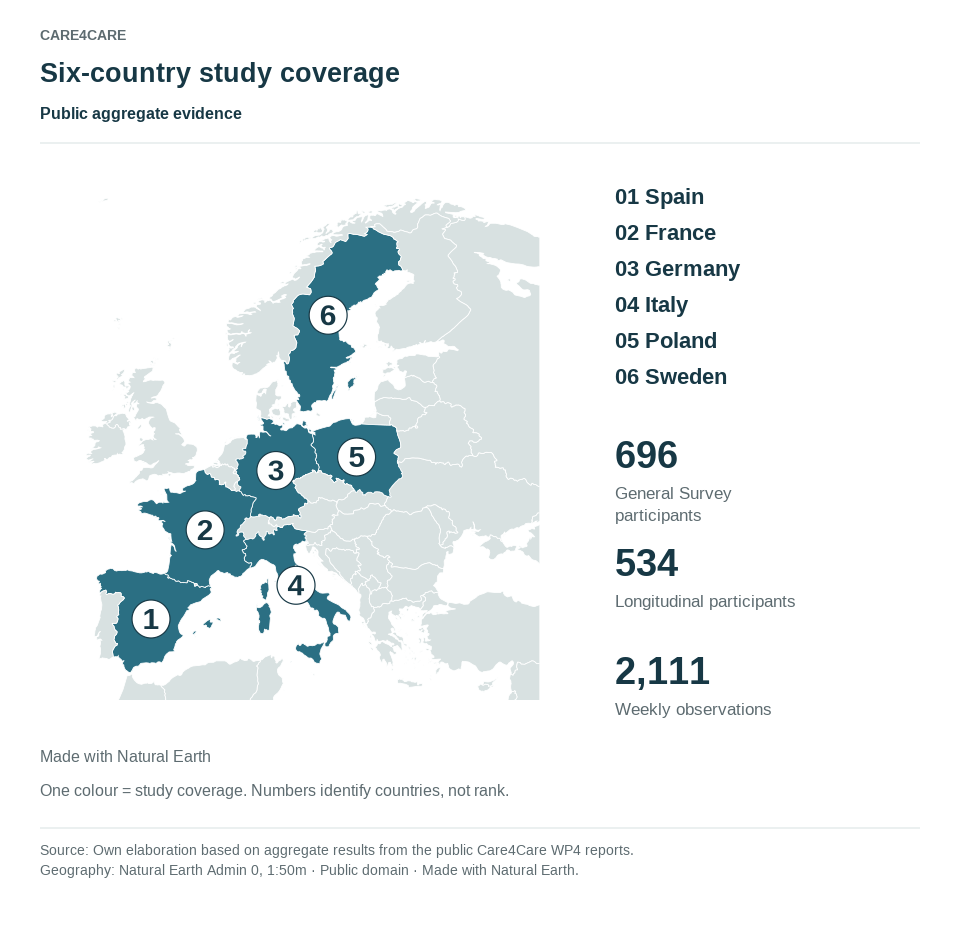
- Spain
- France
- Germany
- Italy
- Poland
- Sweden
- General Survey participants
- 696
- Longitudinal participants
- 534
- Weekly observations
- 2,111
Participants and weekly observations are different units. Colour marks coverage only.
Six countries contributed to the multinational study. The totals come from the complete six-country tables, not the earlier five-country report.
Own elaboration based on aggregate results from the public Care4Care WP4 reports. Geography: Natural Earth Admin 0 · 1:50m · Public domain. Made with Natural Earth.
The challenge
Care work is essential but often characterised by demanding working conditions, psychosocial strain and limited organisational resources.
Care4Care aimed to generate evidence on how these conditions affected workers across different European contexts and to translate that evidence into recommendations for organisations, policymakers and social partners.
Within the University of Seville team, my work focused on a practical research challenge:
How do you collect, harmonise and analyse comparable workforce data across multiple countries, languages and repeated measurements—and turn those data into useful insights about working conditions and well-being?
Building the evidence base
My involvement began with a mixed-methods systematic review of the antecedents of home care workers' well-being.
The final review synthesised 79 quantitative, qualitative and mixed-methods studies, using a structured evidence-synthesis approach informed by PRISMA, JBI guidance and MMAT quality appraisal.
I was first author and the published contribution statement identifies me as lead for data curation, formal analysis, visualisation and drafting of the original manuscript.
The review provided an evidence foundation for understanding recurring themes in the sector, including workload, emotional demands, organisational support, training, information flow and relationships at work.
For the portfolio, this serves mainly as evidence of methodological rigour and my ability to synthesise complex evidence—not as the central story of the case study.
Evidence foundation · Systematic review
Public aggregate evidence
79 studies in the final published review
- Quantitative studies
- 32
- Qualitative studies
- 31
- Mixed-methods studies
- 16
Paid home care workers · 79 studies, not study participants. JBI / PRISMA · MMAT appraisal · Convergent integrated synthesis.
The review provides a supporting evidence foundation. Its 79 included studies concern paid home care workers and are separate from the six-country empirical study.
Own elaboration based on the published systematic review in The Gerontologist. CC BY 4.0.
Designing and running a six-country study
The empirical research involved care workers in Spain, France, Germany, Italy, Poland and Sweden.
I contributed to questionnaire selection and adaptation, preparation of multilingual versions and survey implementation in Qualtrics. The translation workflow I worked with used AI-assisted first drafts followed by human review from native speakers, rather than relying on machine translation alone.
The quantitative design combined:
General Survey in three parts + four weekly questionnaires
The repeated component allowed the project to capture shorter-term variation rather than relying entirely on one retrospective survey.
Once participants entered the study, the operational workload continued across multiple weeks. Together with the other research technician, I helped manage survey scheduling, participation tracking, identification of missing responses and follow-up reminders across countries.
The resulting research dataset included:
696 General Survey participants
534 participants with longitudinal data
2,111 weekly observations
This required continuous coordination rather than a single survey launch.
Multilingual research operations
Reconstructed process · No participant data shown
- Prepare language versions
AI-assisted first drafts support preparation of the multilingual questionnaires.
- Human language QA
Native speakers review wording; response equivalence and consistency require human checks.
- Implement the surveys
Prepare and implement the General Survey and weekly questionnaires in Qualtrics.
- Recruitment & consent
Care workers enter the study voluntarily after informed consent.
- Week 1 · General Survey
Three parts: control variables, risk and protective factors, and well-being outcomes.
- Weeks 2–5 · Weekly questionnaires
Four weekly questionnaires, reminders and completion checks sustain the repeated component.
Editorial reconstruction of the workflow. It is not an operational tracker or a claim of personal back-translation or psychometric validation.
Preparation, human QA and repeated survey delivery connect research design with multiweek operations. The diagram shows stages, not operational records or individual participation.
Own elaboration based on Care4Care’s public methodology and the work carried out within the project.
From multilingual responses to analysis-ready data
This was one of the most substantial parts of my role.
Survey data arrived from different countries and language versions. Before meaningful analysis could begin, those responses needed to be checked, standardised and integrated.
I:
- reviewed whether numeric codes correctly matched equivalent responses across language versions;
- checked consistency between country datasets;
- identified and resolved data-structure and coding issues;
- consolidated responses into common analytical formats;
- maintained separate structures for cross-sectional/general-survey data and longitudinal weekly data.
The result was two principal analysis-ready datasets:
General / cross-sectional dataset
Longitudinal / repeated-measures dataset
This work is central to the case study because the analytical challenge was not simply “run statistics in SPSS.” Reliable workforce insights depended first on ensuring that data collected in different languages and national contexts were comparable.
From language versions to analytical structures
Reconstructed process · No participant data shown
- Country & language versions
Bring the multilingual survey structures together for review.
- Response & code equivalence
Check that equivalent responses correspond to equivalent numeric codes.
- Structure & consistency checks
Review country structures and resolve inconsistencies before consolidation.
- Consolidate common analytical formats
Maintain separate structures for cross-sectional and repeated-measures analysis.
General Survey structure for cross-sectional analysis.
Weekly questionnaire structure for repeated-measures analysis.
Published longitudinal inclusion criterion: at least three consecutive weekly questionnaires. No real response codes, records or identifiers are displayed.
Equivalence checks and common formats precede analysis. The two outputs remain distinct; this reconstruction does not disclose a codebook or an internal mapping specification.
Own elaboration based on Care4Care’s public methodology and the data-harmonisation work carried out within the project. No exports or internal mappings are reproduced.
Quantitative workforce insights
Within the technician team, I held the primary technical responsibility for the quantitative analysis stream, working mainly in SPSS.
The analysis included methods such as descriptive analysis, ANOVA, regression, reliability assessment and repeated-measures analysis, depending on the research question.
Rather than focusing the portfolio on individual statistical tests, the important outcome was the pattern they helped reveal.
The project examined how psychosocial demands and resources related to indicators of worker well-being. Measures covered areas such as workload, emotional demands, conflict and incivility, autonomy, development opportunities, predictability, workplace support, burnout, physical exertion, turnover intentions, work–private-life interaction, happiness and flourishing.
Across analyses, the results helped distinguish between conditions that represented sources of strain and those that could function as protective resources.
Selected aggregate indicators · N=696
Public aggregate evidence
- Burnout
- 2.71 / 4
- Scale 1–4
- Turnover intention
- 2.23 / 5
- Scale 1–5
- Work–private-life conflict
- 2.64 / 5
- Scale 1–5
- Flourishing
- 5.53 / 7
- Scale 1–7
Published means, each on its own scale. These are not prevalence percentages or directly comparable magnitudes. No thresholds are applied.
Four selected aggregate well-being indicators from the General Survey, N=696. Values and scale limits are transcribed from the public deliverable without normalisation.
Own elaboration based on aggregate results published in the public Care4Care WP4 reports.
Bringing quantitative and qualitative evidence together
Care4Care also included focus groups and qualitative analysis.
My qualitative role was more limited: I transcribed some focus groups, occasionally participated as a second facilitator and contributed to discussions about how the qualitative findings should be interpreted alongside the quantitative results.
I contributed to qualitative fieldwork and cross-method interpretation; another research technician led the qualitative analysis stream.
This division allowed us to combine different perspectives without overstating individual responsibility for both methodological streams.
From evidence to recommendations
I was a co-author of D4.2, D4.3 and D4.4, the three public empirical deliverables from Care4Care's Work Package 4.
My main technical responsibility within this work remained data preparation, quantitative analysis and interpretation of the quantitative findings.
The reporting process translated research evidence into accessible findings and practical recommendations for professional and policy audiences.
I also co-delivered an online session for Spanish care-sector stakeholders. I presented the quantitative findings, while my colleague presented the qualitative results.
This is an important part of the case study: the work did not stop at analysis. It required moving from:
data → findings → interpretation → recommendations → professional communication
From evidence to professional communication
Reconstructed process · No participant data shown
- Data
Prepared survey evidence and complementary qualitative findings.
- Findings
Quantitative workforce insights and the distinct qualitative analysis stream.
- Interpretation
Bring the evidence streams together under scientific supervision.
- Recommendations
Translate the findings into accessible recommendations for professional and policy audiences.
- Professional communication
Public reports and communication to care-sector stakeholders.
Contribution boundary: primary technical responsibility for quantitative preparation, analysis and interpretation; another technician led qualitative analysis.
Public outputs: D4.2 · D4.3 · D4.4
Complementary chapters: Institutional care · Home-based care
A reconstructed chain connects analysis with public outputs and professional communication. It does not imply implementation, policy impact or an individual claim to the qualitative analysis.
Own elaboration based on Care4Care’s public reports, public publications and the work carried out within the project.
My contribution
Across Care4Care, my strongest areas of contribution were:
multinational survey operations · multilingual data QA · cross-country data harmonisation · quantitative analysis · evidence synthesis · research reporting · stakeholder communication
I did not lead the consortium or the qualitative analysis stream. My role was substantial technical and analytical execution within the University of Seville research team and the wider international project.
Selected public outputs
Research ethics & confidentiality
The portfolio will use only public aggregate results and public research outputs.
Participant-level datasets, identifiers, contact information, Qualtrics exports, internal trackers, focus-group transcripts, ethics documentation and unpublished analytical files will not be displayed.
Internal processes will be represented through reconstructed diagrams rather than screenshots of working research systems.